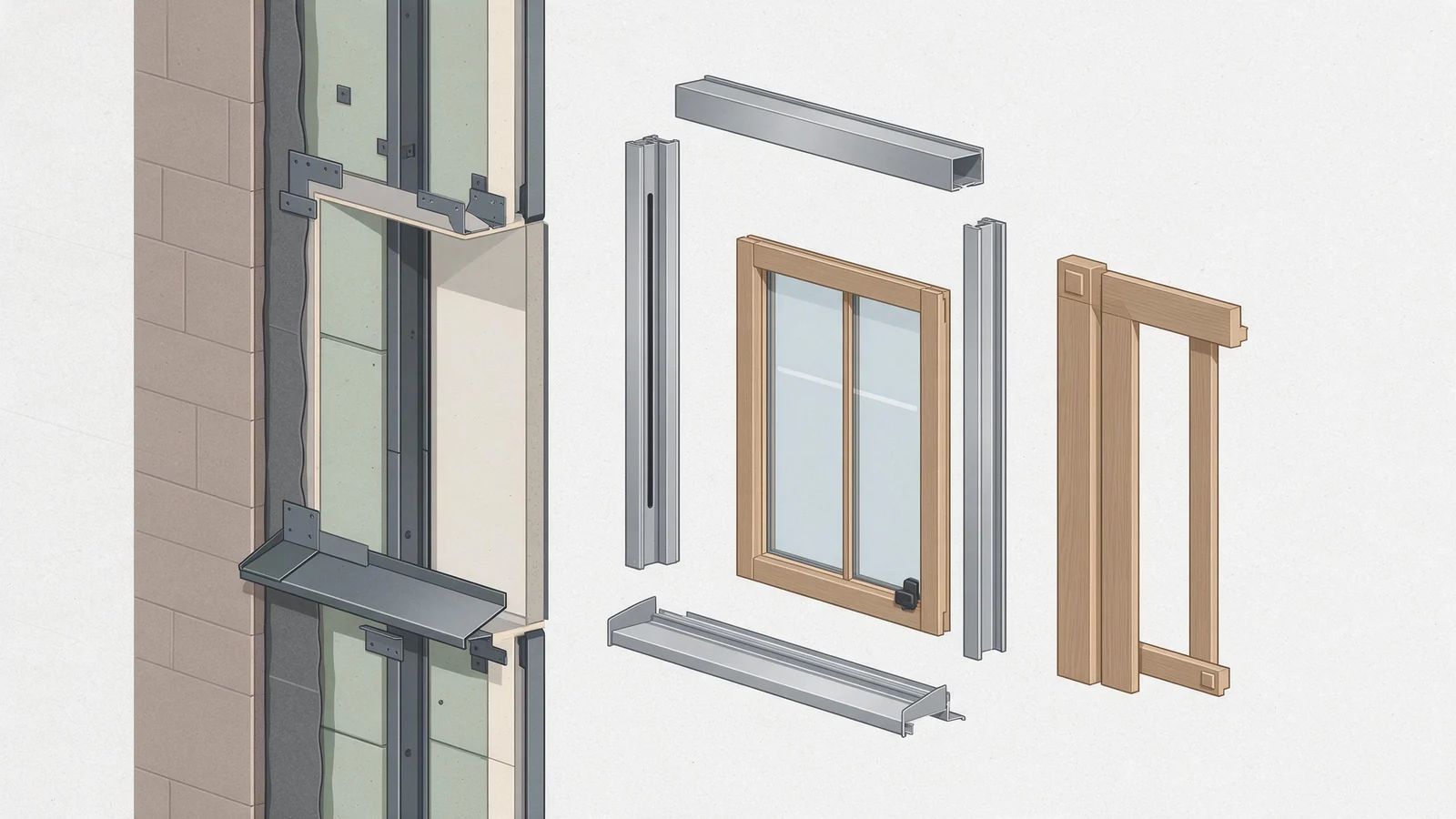
What Is a Window Jamb? Definition and Function
You've got two side jambs, a head jamb across the top, and the sill. They line the rough opening, hold the glass and the sash, keep the frame square under wind and its own weight, and the sash slides or swings on them without wobbling. But the inside faces have to stay straight and parallel, or the sash binds and rattles. That squareness is what you're paying for when the opening is out.
And don't mistake the jamb for trim. Casing or architrave just covers the gap between frame and wall. The jamb is the working part. A jamb liner is often added inside to cut drafts and help the sash move smoothly.
With aluminium and uPVC, you don't nail on a separate jamb later. The extrusion itself comes with the track for the sash, the groove for the weatherstrip, and the screw bosses to fix the frame to the wall, so the jamb is built into the same profile.
Window Jamb vs. Window Sill vs. Window Casing: Key Differences
| Part | Position | Function | Material examples |
|---|---|---|---|
| Window jamb | Vertical sides and top of the frame | Structural support, sash guidance | Aluminium, uPVC, wood, fiberglass |
| Window sill | Horizontal bottom piece | Supports the frame, sheds water outward | Stone, aluminium, uPVC, wood |
| Window casing | Trim around the frame, on the interior or exterior | Conceals the joint between frame and wall | Wood, MDF, PVC, aluminium |
People will call in and say jamb when they mean the whole frame. That throws the order off. In the factory we split it into side jambs, the head jamb up top, and the sill. Every extrusion and cut list carries those labels, so get them straight before you order.
Materials Used for Window Jambs: Wood, Vinyl, Aluminum, and More
Most jambs are made from the same material as the frame. Wood, vinyl, aluminium, fiberglass, composite. They don't behave the same way on site.
- Wood: Cuts and fits easily, but if moisture gets in, the jamb rots. Paint or seal it regularly or you'll be back to replace it.
- Vinyl (uPVC): Handles water better and needs less upkeep. Cheap and does the job, which is why you see it in so many homes.
- Aluminium: Strong enough for big panes and high wind loads, so it shows up in commercial work and high-rises. If you don't seal it properly, you lose energy performance.
- Fiberglass and composite: More durable than plain wood and resist moisture. Often spec'd for high-performance windows where wood would fail.
For commercial buildings, aluminium wins. Having the option to thermally break the extrusion makes a real difference in heat transfer, and the jamb can take double or triple glazing. That's not what you need in a house, where uPVC's lower cost and better thermal performance per dollar actually matter more than extreme strength, which is why you see it in residential and light commercial work.
Window Jamb Depth and Extensions: Why They Matter in Construction
Jamb depth runs from the inside edge of the frame to the exterior cladding. Match it to the wall thickness. A wall thicker than the jamb depth pushes the frame too deep into the opening, or leaves it sitting shallow. Thicker walls need jamb extensions. That filler piece carries the frame out to the interior face. Think thick masonry in old buildings, or timber frame with deep studs. Those usually need extensions.
Wrong jamb depth means air leakage and poor energy performance. Seal and insulate the gap between frame and wall. A jamb that is too shallow can stop interior trim from covering the rough opening, and cold air bypasses the insulation. On commercial curtain walls, the system supplier often gives the jamb depth. You coordinate that with the structural engineer.
For custom aluminium windows, tell us the exact wall thickness at the opening. We can extrude or fabricate the jamb to that depth, or supply matching extensions.
Common Window Jamb Problems and Repair Options
Poor sealing traps water against the timber and that's where rot begins. Older timber windows fail this way more than any other. The fibres break down from repeated wetting, the jamb softens, and the sash won't hold. Air leaks past the sash once the weatherstripping inside the jamb liner wears out, and that costs you energy efficiency. Warping twists the sash enough that it won't close properly.
Minor rot you can sometimes repair by cutting out the bad section, reinforcing with timber, and resealing the joint. If the side jambs crumble or the head jamb is compromised deep, you're looking at jamb replacement. Aluminium windows don't rot, but thermal bridging can occur if the profile is not thermally broken. Heat moves through the metal frame, and you get condensation and energy loss.
Installation is really the best prevention. The window jamb has to sit even inside the rough opening, the sill needs to slope outward, and the head jamb must carry weight balanced across the side jambs. Seal around the jamb properly and you get better energy efficiency and thermal performance. Weatherstripping along the jamb liner boosts insulation and energy efficiency.
Window Jamb Installation and Maintenance Best Practices
Start with a square, level rough opening. Set the frame in place and shim it until plumb and square. The shims carry the window's weight into the structure. Pack or foam the gap between jamb and rough opening to stop air movement.
Cut the jamb extension to measured depth and fasten it to the frame. Seal that joint. Air leaks through if you skip it. For commercial work, get a professional install. Tolerances are tighter there, and the window has to hit specified air and water performance.
Maintenance comes down to weatherstripping and seals. Inspect them regularly and replace weatherstrip that's compressed or cracked. Check the jamb for water staining or movement. On aluminium frames, clean the tracks and drainage holes so water can escape. That attention keeps the sash moving smoothly and the building envelope tight.
Window Jamb in Aluminum and uPVC Window Systems
Aluminium jambs work off one profile that does the outer frame, the sash track, and the glazing bead. How deep that jamb runs comes from the profile series, which is sized for the wall thickness and glass type you are dealing with. Many systems put a thermal break in there, a low-conductivity polymer strip separating the inner and outer parts of the profile. That cuts heat transfer and raises energy efficiency.
uPVC jambs are multi-chamber extrusions. The hollow chambers trap air and slow heat movement, and builders slide steel or aluminium reinforcement inside the chambers when they need strength. Corners get welded for a strong, sealed frame.
Aluminium carries larger glass areas and stays stronger, but it conducts heat unless thermally broken. uPVC insulates better without extras, yet it is less rigid, so large windows may need reinforcement. Cost depends on the profile system, finish, and hardware. For commercial work in hot climates, thermally broken aluminium is common because it gives you strength and acceptable thermal performance together.
Window Jamb vs. Door Jamb: Similarities and Differences
A door jamb holds the door, defines the opening, and provides structural support, just like a window jamb does. But the hinges live on one side and the strike plate for the latch or lock sits on the other. That changes the build. Door jambs are thicker and reinforced, especially once you get into heavy doors or anything security rated. A window jamb guides a sash that slides or swings, nothing more. A door jamb absorbs the repeated impact of the door closing, plus it has to keep the door square under its own weight.
On commercial jobs you see aluminium door jambs all the time, because they tie straight into the window system and give a uniform facade. Both go in plumb and square. Both need sealing and insulation around the rough opening. The big difference is hardware load, plus the threshold or sill you need at the bottom of the door.
Window Jamb and Glazing: How the Frame Supports the Glass
The jamb holds the sash, so it holds the glazing too. Designing Buildings defines glazing as the glass part of the facade or internal surface. The glass sits in the sash, so the jamb carries it. The jamb depth has to fit the glazing unit plus whatever gaskets or setting blocks are packed around it.
Double glazed units are two sheets of glass with a cavity between them, usually 4-20 mm, as an insulating barrier. Triple glazed units use three sheets. Insulated glass units combine multiple panes into one system, with pane spacers around the inside edges keeping the panes apart. The cavity can be a vacuum or filled with a heavy inert gas like argon, krypton, or xenon. Argon is the one you see most. Krypton and xenon cost more and insulate better. Jamb depth and profile have to match the glazing thickness. A slim-frame aluminium sliding door with 8mm glass needs a jamb profile that holds that glass firmly and still keeps the frame narrow, which is why you pick the glazing type and jamb system together when you specify windows.
For aluminium and uPVC options, see our aluminium windows and uPVC windows and doors pages. If you need a specific frame depth or glazing configuration, contact Winway with your wall section and opening sizes. We do that every day.